Every game.
Every structure, every table.
The catalogue
Thirteen games.
And the rotations that mix them.
Hold'em
No-Limit Hold'em
The world's game, with every straddle and ante option.
2 hole cards · 5-card board
- Deck
- 52 cards
- Structures
- No-Limit
- Hands
- High · any five of seven
- Distinct
- Blinds and antes, every straddle.
Hold'em
Pot-Limit Hold'em
Hold'em with pot-limit betting.
2 hole cards · 5-card board
- Deck
- 52 cards
- Structures
- Pot-Limit
- Hands
- High · any five of seven
- Distinct
- The pot limit, computed by the engine.
Hold'em
Fixed-Limit Hold'em
Small and big bets, the half-bet rule for short all-ins, a four-bet cap uncapped heads-up.
2 hole cards · 5-card board
- Deck
- 52 cards
- Structures
- Fixed-Limit
- Hands
- High · any five of seven
- Distinct
- Small bets, big bets and a raise cap.
Omaha
Pot-Limit Omaha
Four hole cards, exactly two used, pot-limit raises computed by the engine.
4 hole cards · 5-card board
- Deck
- 52 cards
- Structures
- Pot-Limit
- Hands
- High · exactly two plus three
- Distinct
- A constrained evaluator and pot-limit maths.
Omaha
Omaha Hi-Lo
Split pots between the best high and the best eight-or-better low, pot-limit or fixed-limit.
4 hole cards · 5-card board
- Deck
- 52 cards
- Structures
- Pot-Limit · Fixed-Limit
- Hands
- High, and an ace-to-five low, eight or better
- Distinct
- Split pots with low eligibility per pot.
Omaha
5-Card PLO
Five hole cards for bigger draws and bigger pots, up to eight seats a table.
5 hole cards · 5-card board
- Deck
- 52 cards
- Structures
- Pot-Limit
- Hands
- High · exactly two plus three
- Distinct
- A hundred two-card combinations a hand.
Short Deck
Short Deck
36 cards, flushes over full houses, ante-driven action with a button blind.
2 hole cards · 5-card board
- Deck
- 36 cards, 2–5 removed
- Structures
- No-Limit · Pot-Limit
- Hands
- High · flush over full house
- Distinct
- A-6-7-8-9 is the lowest straight.
Stud
Seven-Card Stud
Bring-ins, up cards and seven streets of the classic.
2 down, 4 up, 1 down — no board
- Deck
- 52 cards
- Structures
- Fixed-Limit
- Hands
- High · best five of seven
- Distinct
- Antes, a bring-in and up cards that set the order.
Stud
2 games
Stud Hi-Lo and Razz
Split-pot stud and lowball stud.
2 down, 4 up, 1 down — no board
- Deck
- 52 cards
- Structures
- Fixed-Limit
- Hands
- Hi-lo eight or better · Razz: ace-to-five low
- Distinct
- Razz brings in on the highest up card.
Draw
2 games
2-7 Triple Draw and Single Draw
Deuce-to-seven lowball with one or three draws.
5 down · 3 draws · or 1 — no board
- Deck
- 52 cards
- Structures
- Fixed-Limit · No-Limit
- Hands
- Deuce-to-seven low
- Distinct
- Draw rounds and a reshuffled muck.
Draw
Badugi
Four-card lowball across four suits.
4 down · 3 draws — no board
- Deck
- 52 cards
- Structures
- Fixed-Limit
- Hands
- Badugi · four suits, four ranks
- Distinct
- A four-card badugi beats any three.
Mixed
Mixed games
H.O.R.S.E., 8-Game and custom rotations at cash tables, switching game by orbit with one stakes for every game.
H.O.R.S.E.
- Limit Hold'em
- Limit Omaha Hi-Lo
- Razz
- Stud
- Stud Hi-Lo
8-Game
- H.O.R.S.E.
- 2-7 Triple Draw
- No-Limit Hold'em
- Pot-Limit Omaha
- Deck
- Per game
- Structures
- Per game
- Hands
- Per game
- Distinct
- H.O.R.S.E., 8-Game and the operator's own rotations.
Betting structures
No-Limit. Pot-Limit.
Fixed-Limit, to the letter.
NL
No-Limit
- Bet anything up to your stack.
- A raise is at least the last full raise.
- A short all-in does not reopen the betting.
PL
Pot-Limit
- At most the call plus the pot after it, dead money included.
- At least what no-limit allows.
- The Pot button is the server's maximum, to the chip.
FL
Fixed-Limit
- One size a street: the small bet, then the big bet from the turn.
- Four bets a street — uncapped when it is heads-up before the cap.
- Half a bet or more all in is a full bet; less is completed.
The cap, enforced by the decision
In a limit game the engine offers one size, or nothing. After the fourth bet before the flop, the next player's decision carries no raise at all — the client cannot offer one, and the server would refuse it.
Pre-flop
2
small bet
Flop
2
small bet
Turn
4
big bet
River
4
big bet
Blinds 1/2: the small bet is the big blind, the big bet twice it.
{
  "event": "ActionTaken",
  "seat": 1,
  "action": { "type": "Raise", "amountTo": 8 },
  "committedThisStreet": 8,
  "stackAfter": 92,
  "allIn": false,
  "fullRaise": true,
  "seq": 16,
  "streetIndex": 0
},
{
  "event": "DecisionRequested",
  "decision": {
    "seat": 2,
    "streetIndex": 0,
    "legal": ["Fold", "Call"],
    "callAmount": 6,
    "minRaiseTo": 0,
    "maxRaiseTo": 0,
    "raiseCapReached": true
  },
  "seq": 17,
  "streetIndex": 0
}
At the table
The games that make a room.
Run it twice, bomb pots, the 7-2.
Run it twice — or three times
Players all-in choose to run the board more than once, with equity shown and the pot split by board.
All-in insurance
Heads-up and all in, the favourite can insure the contested pot at a price set by their equity — paid from the wallet in its own ledger entries, so the pot and the rake never change.
Bomb pots and the 7-2 bounty
Everyone antes and sees a flop, on one board or two; a seven-deuce that wins the main pot collects a bounty from every seat — the games that make a room fun.
Straddles
Under-the-gun, button and Mississippi straddles, re-straddle chains and short-stack all-in straddles — or none, by house rule.
Seat 0 · all in
Seat 1 · all in
RunsAgreed · runs 2 — a pot of 200
First board
Seat 1 wins 100 with three kings
Second board
Seat 0 wins 100 with a pair of aces
Player0: raises to 100 and is all-in
Player1: calls 100 and is all-in
Player0: shows [As Ad]
Player1: shows [Kc Kd]
Players agree to run it twice
*** FLOP *** [Kh 7c 2d]
*** TURN *** [Kh 7c 2d 9s]
*** RIVER *** [Kh 7c 2d 9s 4h]
*** SECOND BOARD *** [5c 8h Jc 3s 6d]
// … showdown
Player1 collected 100 from pot on the first board
Player0 collected 100 from pot on the second board
Table settings
- RunItMultiple
- RunItTimes
- BombPotEveryHands
- BombPotAnte
- BombPotBoards
- SevenDeuceBounty
- SevenDeuceSuitedCounts
Each hand's share of the pot — exact with one or two cards to come, a seeded sample otherwise — so the same hand always shows the same numbers.
Cash games & private rooms
Public tables.
Home games. Both run themselves.
A room's life
- Open
- Running
- Paused
- Closing
- Closed
Closing finishes the hand in play, cashes every player out and takes the room off the lobby. The room is the only arbiter of its seats: two players claiming the last one at once get one seat and one debit between them.
Public, private and invite-code rooms
Rooms listed in the lobby, private to the owner's invitees, or reached with an invite code — checked when a player joins and again when they sit.
Waitlists that seat themselves
An ordered waitlist seats the next player automatically at the hand boundary, with head-of-list priority on the last seat.
Seat change
Immediate between hands, and deferred to the end of the hand when asked for in play.
Rebuy and top-up
The wallet is debited at once and the chips arrive at the next hand boundary — never in the middle of a hand.
Sit-out and stand-up
Sit out by choice or automatically after repeated timeouts, stand up after sitting out too long, and empty rooms close themselves.
Owner controls for home games
The owner invites and removes players, pauses, resumes and closes the room, and changes its stakes, timers and name between hands.
Room templates
Ready-made tables by game, stakes and size — six-max, heads-up, limit and run-it-twice — opened in one step.
Spectators, safely
Each room sets whether spectators may watch, and a spectator's stream never carries a hidden card.
Games per market
Each market sees
what its licence allows.
- Rooms, tournament templates and the back office all check the engine's one catalogue where a game is configured — never at the first hand.
- Switching a game off stops new rooms and tournament templates of it; tables in play and schedules already set up carry on.
- Each connection is placed by geolocation; a seat, waitlist, entry or new table of a game not offered there is refused, and the lobby lists only what the player may play.
Games offered · by jurisdiction
| Market | Games |
|---|---|
| Default | NLHE |
| MT | NLHEPLO |
| US | none |
| US-NJ | NLHE |
Where a player lands
- MaltaMT →NLHEPLO
- New JerseyUS-NJ →NLHE
- NevadaUS-NV → US →seat refused
- Great BritainGB → Default →NLHE
The player's screen
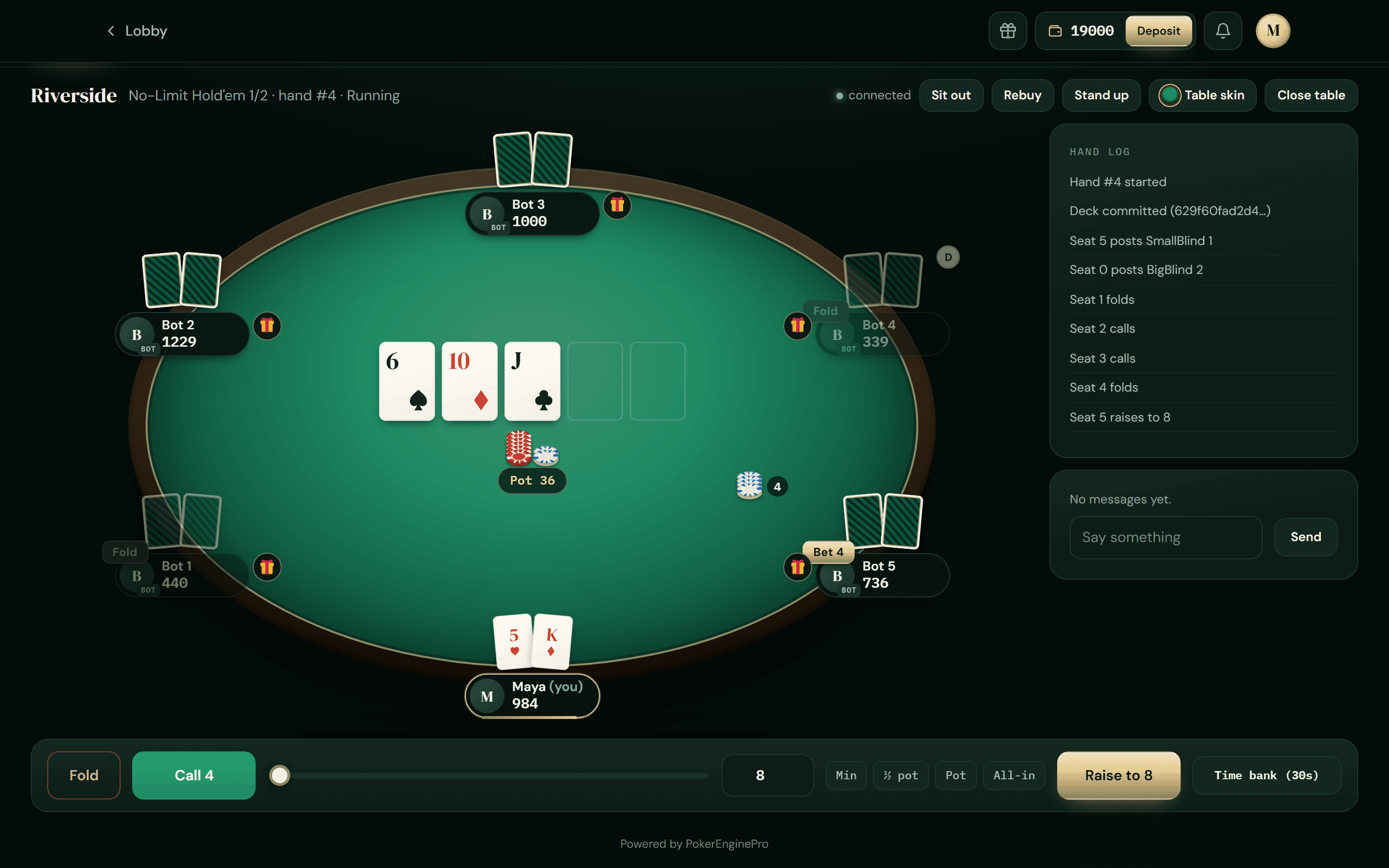
Drawn from events.
Driven by the server.
01
Events in
A room's burst of events arrives as one batch, in sequence; a gap asks for a fresh snapshot.
02
One reducer
The client holds no poker rules: one reducer rebuilds the table, tested against the engine's golden hands.
03
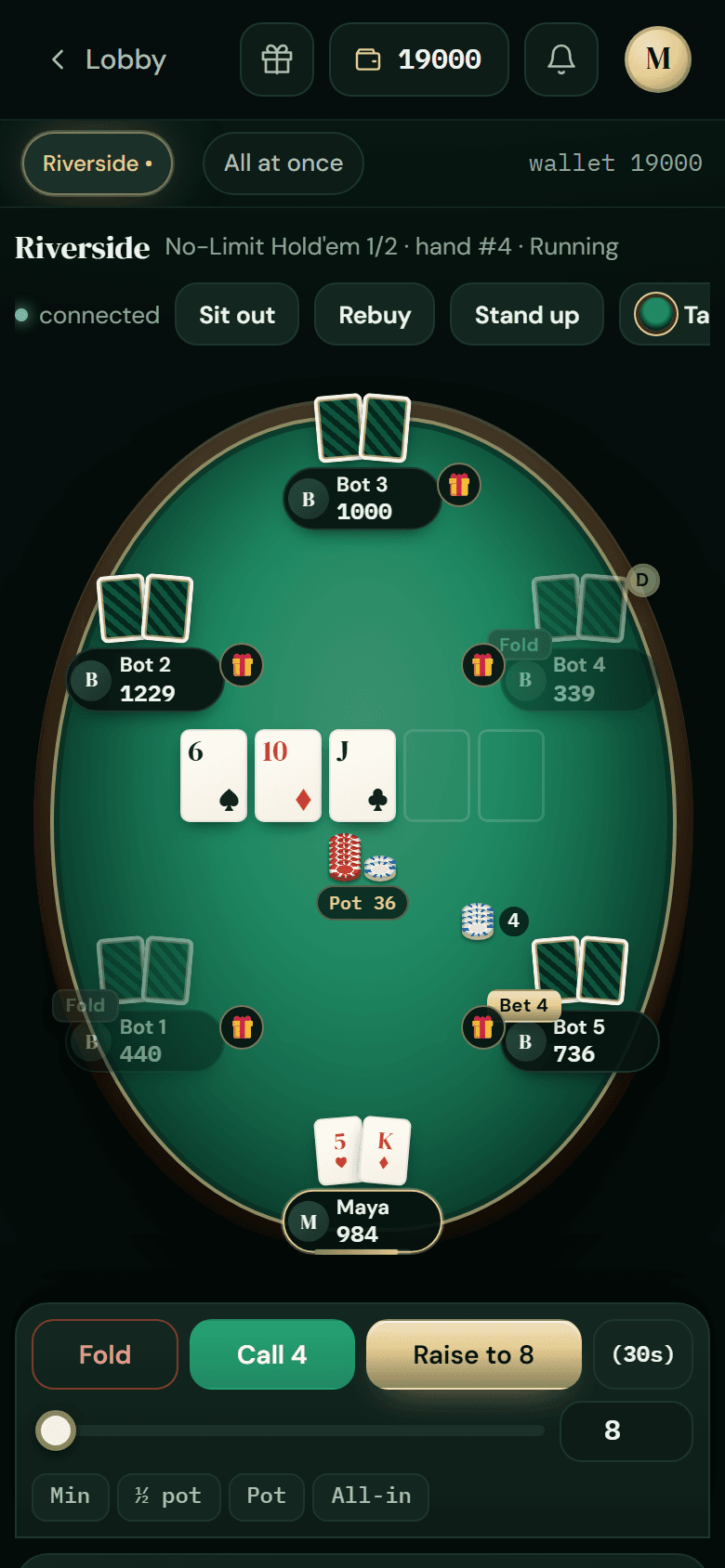
The felt
Each table redraws only itself, so four tiled tables cost one felt per event, not four.
04
The action bar
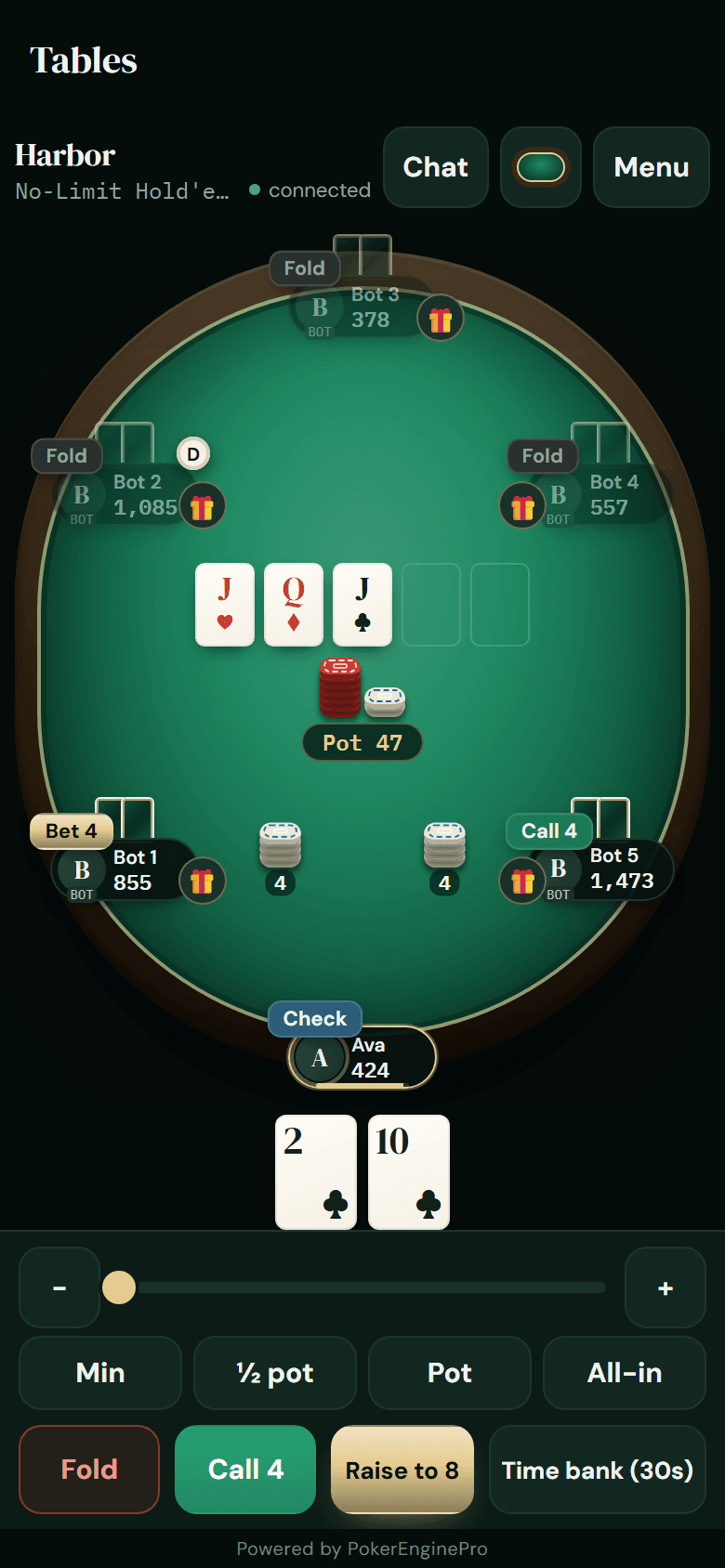
Fold, call, raise and the slider's bounds come from the server's decision, never the client.
Multi-tabling
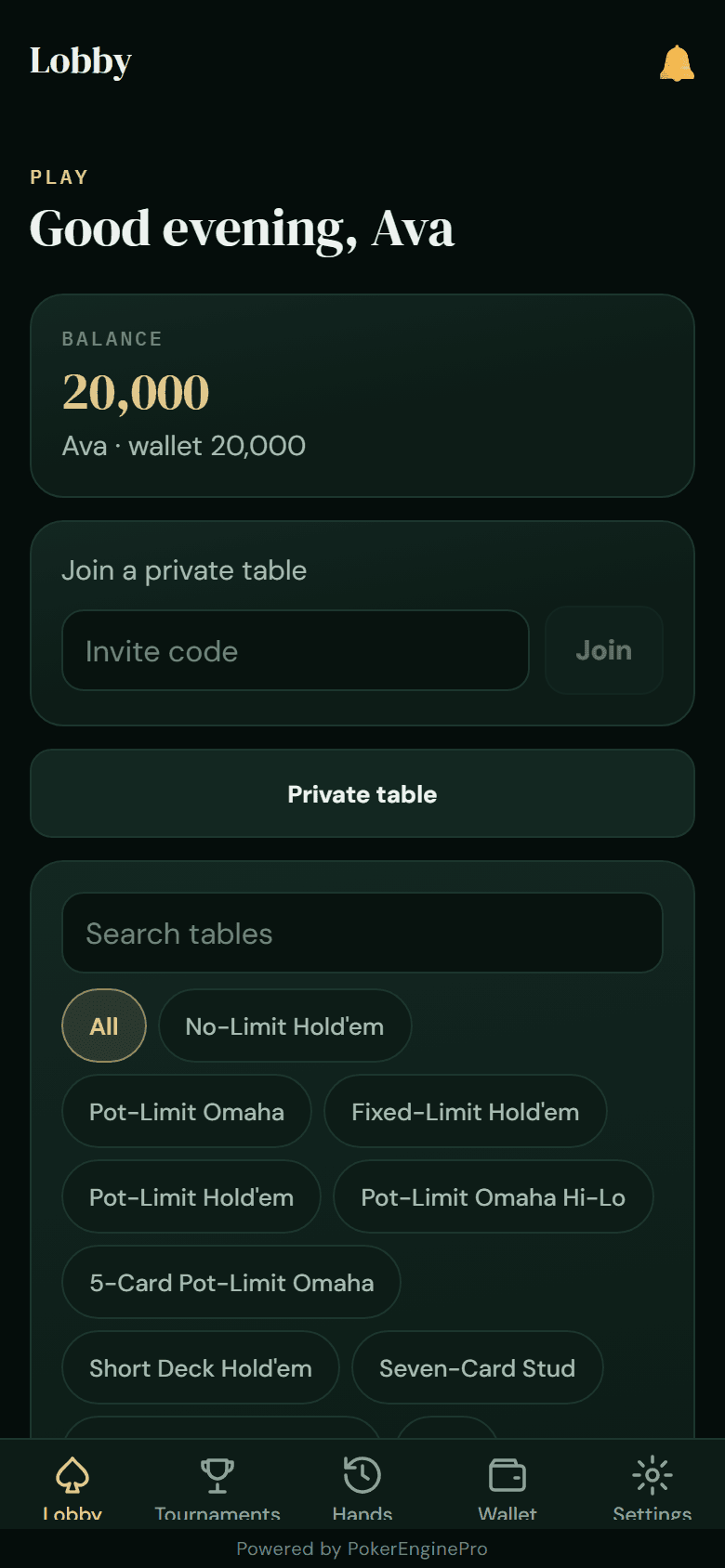
The web client on a phone
Your brand on the felt
Native mobile apps
Pick your games.
We will deal them.
A walkthrough of the catalogue, the table extras and the home-game controls — on a live table, with the hand history to prove it.